
The real problem isn't AI, it's your content
5 August 2025 | Eric Lamy | 14 min read

Discover why your content is no longer engaging and how to write useful, credible, and distinctive articles in the era of artificial intelligence.
The other day, I came across an article that promised to explain how to optimize the performance of an e-commerce site in 2025. It had an interesting theme, a well-formulated title—it had it all. But from the first sentence, I knew I was dealing with AI-generated text. Not because of a clumsy word or a shaky turn of phrase. No. What struck me was the complete lack of soul. No intention, no bias, no perspective. Just a series of clean, polite, but empty sentences. The kind of content that strings together obvious facts to the point of exhaustion. I closed the tab before I even reached the second paragraph.
It’s not the AI that’s betraying you. It’s how we use it. And that’s the problem: **artificial intelligence has transformed content into a commodity. ** Like any commodity, it quickly loses its value.
In this article, we’re not going to debate AI vs. human . That debate is outdated. We’re going to talk about something else: **value, attention, credibility, and, most importantly, what your readers detect in the first few seconds. ** We’re going to show you why your content is missing its target—and, most importantly, how to fix it.
AI didn’t kill copywriting. It just finished the job.
Long before ChatGPT, web content was already in crisis. The writing market gradually aligned itself with an industrial logic: produce quickly, produce in mass, produce cheaply. By constantly demanding texts at €5 per 500 words, the result was predictable. Quality was degraded, formats standardized, and any room for style or thought was eliminated. AI didn’t invent anything. It simply completed what the market had already started.
From 2020 to 2024, the average price of an SEO article fell drastically, by up to 70% for some so-called “informative” content. Platforms have normalized this drop: Fiverr, Textbroker, Upwork, all now offer articles generated, reworded, or translated automatically. All of this, often proofread by a human… paid a few cents per word.
On the client side, the same shift has occurred. For many, “having content” has become a line in a marketing table, like a Google Ads campaign or a product sheet update. We produce to tick a box, not to convey an idea.
At Agerix, we’ve seen several companies that have tried the “AI option .” Some have asked a marketing assistant to generate their product pages. Others have outsourced their blog to a freelancer equipped with GPT. At first glance, everything seemed coherent: optimized titles, clear structure, well-placed keywords. But looking at the metrics, it was a different story: high bounce rate, very low reading time, no sharing, no backlinks . Worse, in some cases, positions lost on competitive keywords .
AI didn't kill copywriting. It simply demonstrated, with formidable efficiency, how interchangeable content had become . And today, readers don't want it anymore.
Why your brain spots AI content in 2.3 seconds
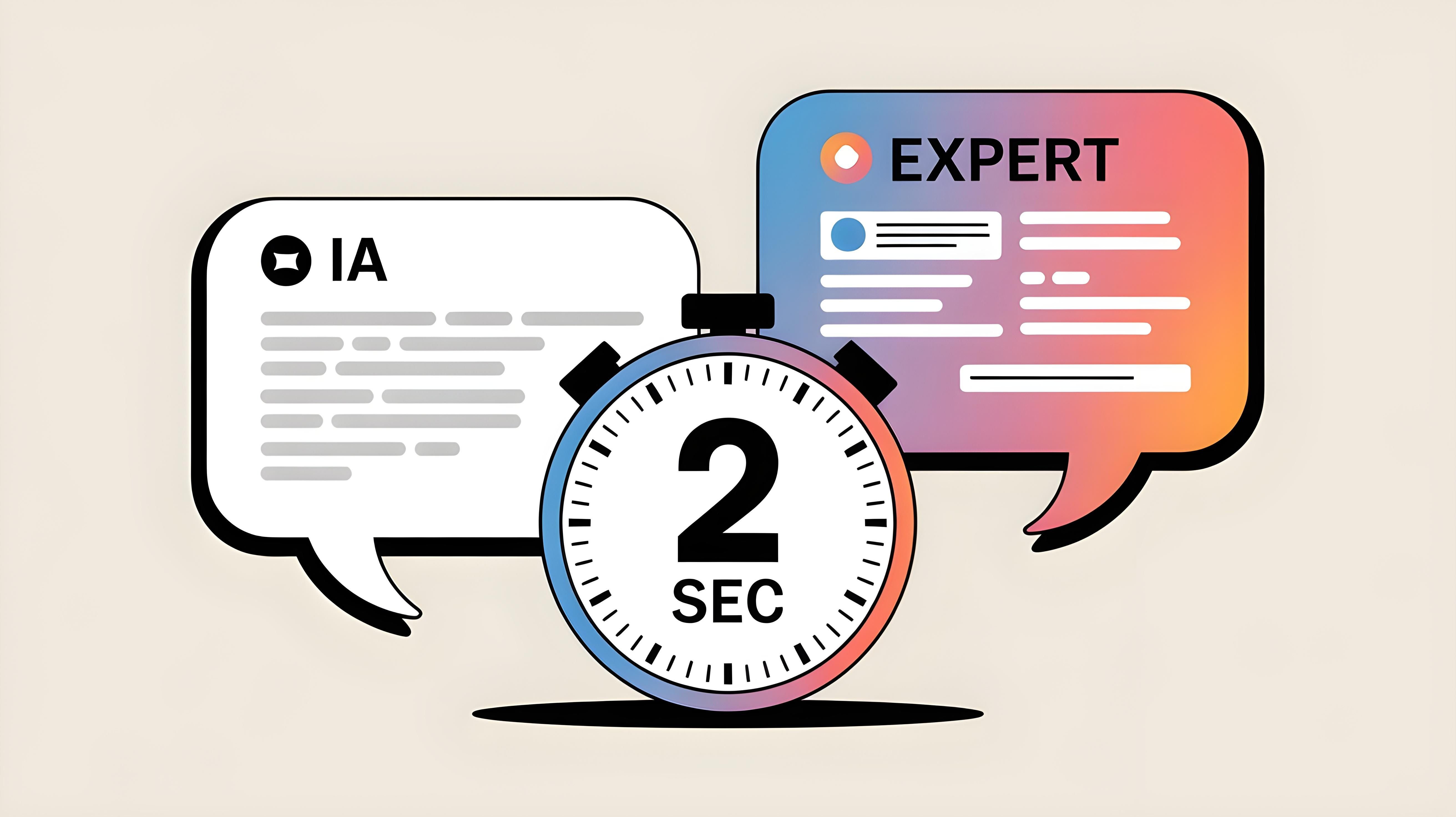
You’ve had this feeling before: you open an article, your eyes scan the first few lines, and something’s off. You don’t know what yet, but you feel like this text won’t speak to you. So you close the tab. This reflex is your brain sorting. Quickly. Very quickly.
According to a study conducted by the Nielsen Norman Group , a US company co-founded by Jakob Nielsen , it takes an average internet user 2.6 seconds to decide whether to stay or leave a page. Another MIT study on visual perception shows that our brains can recognize a familiar pattern or signal in less than 150 milliseconds . In other words, we spot the artifice long before we actually read. What we detect isn’t the technology. It’s **the absence of a human signal. ** No assertive tone. No rhythm. No surprise. Just noise.
But our attention is wired to look for what stands out . An original point of view, an anecdote, a contradiction, a voice. AI, by definition, smooths these elements over to please everyone. And ends up speaking to no one.
At Agerix, during very specific missions, we analyze the editorial performance of our clients. And what we notice is that the content that performs all have one thing in common: a hook that provokes a reaction . Agreement, disagreement, surprise, emotion… it doesn’t matter. What matters is to emerge from the ambient noise. That’s what your reader is looking for. A voice, not a synthesis. Take the example of this blog, we are a design office specialized in business application development , our segment is therefore very technical. If we wrote articles without personalities, bland, we would have closed our doors a long time ago. For a few months Betty, our project manager, has been writing articles on her project management methodology , her tools, etc. And thanks to her writing style, the concrete examples she gives, these articles perform!
What betrays you is not (only) the word “crucial”
When content rings false, it’s not because of a generic word or phrase. It’s not even because of the AI itself. It’s the editorial choices that betray the origin—or worse, the lack of real intent. Here are three mistakes your readers spot instantly. I could have given you more, but these are sure to resonate.
Mistake 1: Obsession with volume
For years, it was believed that “the longer it is, the better it is for SEO.” The result: articles of 2,500 to 3,000 words full of filler, with paragraphs that circle around the topic without ever getting into it. But maintaining a quality pace over 3,000 words is extremely difficult , even for a good writer. AI, on the other hand, can manage this volume without tiring. Except that it produces text, not content. And Google, like your readers, is no longer fooled.
Concrete example: two pages on the same subject (“choosing a CMS in 2025”).
- One is 2800 words long, covers 15 different options, with no hierarchy or point of view.
- The other is 900 words long, analyzes 3 typical use cases, with specific recommendations.
Guess which one keeps the user longer? And which one gets the featured snippet on “CMS for showcase sites”? You already guessed it, the short one, because it answers clearly, quickly, and with substance. This stupid obsession with length was so widespread that a few years ago we added the reading time to the header of our articles to reassure readers that reading would only take them a few minutes. I, too, wrote articles that were too long, too detailed… And by displaying reading times, I realized that few people would devote that much time to me. So I learned to be concise and to stay on target.
Mistake 2: Lack of perspective
AI can explain what a headless CMS is, list its pros and cons, but it will never tell you which one to choose for your situation. It doesn’t take a position. Because it has no experience. Or an opinion. Or a stake. A reader isn’t looking for a Wikipedia summary. They’re looking for a guide . An informed opinion. An editorial risk. This is where expert content makes the difference. Saying “we recommend X in this case, Y in that one” exposes you, yes. But it gives you credibility. AI, on the other hand, remains neutral. And smooth. And forgettable…
When I write an article on this blog, I try to systematically include relevant examples and personal opinions based on my experience and/or training. By doing this, I am putting our agency’s reputation and my credibility at risk, it’s true. And yet, this is what makes our articles work, both from a reader and search engine point of view. Google recognizes the intention in our articles, identifies the internal linking that underlines editorial consistency, notes personalized examples, etc. If you have nothing to say or if you don’t express a clear and assertive point of view, don’t write an article!
Mistake 3: Assumed genericity
Finally, there’s this mistake we see everywhere: flat titles, generic intros, standardized structures. Example? “10 tips for a successful digital strategy in 2025.” We already know the 10 tips. And so does the reader. Conversely, a niche title like “Hiding a washing machine in a 20m² studio: 3 ideas that really work” sets a direction. It speaks to a target audience. It sets a clear intention. This level of precision doesn’t come from a generic prompt. It comes from experience, a profession, a field . And that’s precisely what your readers spot. Or not.
So yes, I know that some of you will look at the list of our articles and will see that we too have fallen into the trap . It’s true… And if I give this third error here it is precisely because it is easy to fall into the trap. Take the titles of YouTube videos on AI and you will see an explosion of overbidding. By dint of reading these titles, we end up succumbing and that is precisely when we must remember the trap! So I promise, I won’t do it again. I hope. 😁
To visually summarize what differentiates AI content from expert content, here is the comparison we use at Agerix to audit our clients’ content:
Our method for creating content that converts (not fills)
I’ve said it before, and I’ll say it again to make it clear. At Agerix, we don’t sell text. It’s neither our core business nor our promise. We are a design office specializing in the development of business applications . When we write, it’s in two well-defined contexts: our own strategic communication , or **specific missions where the content serves a client project, a vision, a product. ** We don’t produce content “on the assembly line.” We build value through the text , directly linked to a business need, a targeted audience, and a measurable objective. This requirement has led us to formalize an editorial production method, which we deploy only when it makes sense : to clarify a positioning, translate technical expertise, reference an innovative product, or guide decision-making.
We’re soon launching a new editorial offering, focused on expert content and strategic SEO. But we’ll do it in the Agerix spirit : never to fill up. Always to build. And here are the principles we follow, and why they work.
1. Start by analyzing the SERP — not by writing
When a client entrusts us with content to produce (product sheet, blog article, documentation, etc.), we never start by opening a text editor. We begin by observing the reality on the ground: the Google results page for the target query.
What types of content are visible there? Should it be a comparison, a tutorial, an expert position, or a UX approach? This phase allows you to avoid two pitfalls: writing off topic, or producing something that’s already been seen.
2. We identify what competitors are not saying
Competitive research isn’t about copying. It’s about finding blind spots . A competitor explaining a feature without a demonstration. A tutorial without a concrete use case. A promise without proof. This is where we make our difference. For example, in a recent project on an HR management application, we noticed that no one was clearly explaining how the software handled split absences between contracts. We made this the focus of a high-profile article.
3. We choose precise, targeted titles, never vague ones
Our titles aren’t aimed at the masses. They’re aimed at the right search , the kind that captures a decision-maker with a real need. Rather than “How to optimize your ERP in 2025,” we prefer: “Modulating an ERP for a growing industrial SME: the 3 scenarios we recommend.” This type of title attracts less overall traffic, but generates more qualified contacts . And that’s what our customers expect.
4. We structure the content around the real questions
We use PAA (People Also Ask) and other search data to build plans that match the expectations of the field. Each piece of content is designed as a direct response to a customer question, formulated in natural language. This helps to reassure, guide, and convince. Not just inform.
5. We give the answer in the first lines
In our SEO-oriented or user response content, we integrate the answer right from the introduction . No need to write 1,200 words before “revealing” what the reader is looking for. This approach improves retention rates, user satisfaction, and the chances of appearing in position zero (featured snippet). Google favors clear, structured, and visible answers.
6. We adopt the logic of the inverted pyramid
In all our content, we start with the value . This applies to an article, but also to product documentation, a landing page, or even pre-sales support. We first provide the essentials (what it is, what it does, why it matters), then we move down to the details, the arguments, the use cases, the evidence. This structure is particularly effective for busy decision-makers, project teams, or purchasing departments.
7. We integrate useful visual formats (and not just decorative ones)
Infographics, comparison tables, flowcharts, project timelines… Agerix projects are often complex and technical; the goal is not to lose the client or project manager along the way, so **each visual has an explanatory function. ** It’s often a matter of translating technical complexity into intuitive reading, the famous “a picture is worth a thousand words.” In one client case, a simple onboarding timeline helped reduce the number of post-registration customer service calls by half.
8. We apply an “emotional audit” before publication
Last step before validation: we ask ourselves this simple, but formidable question:
Trust? Clarity? Relief? Curiosity? If the content doesn’t trigger any reaction, it gets reworked. It’s this requirement for sincerity, readability, and a clear position that makes the difference—even in highly technical contexts.
Why go back to handmade?
A few years ago, we worked with a professional web editor on a winegrowers’ club project. AI wasn’t yet as prevalent as it is today, but we already had access to writing assistance tools. Virginie, our professional copywriter, told us that regardless of the quality and future of these tools, the writer’s touch will remain essential. She was right, and this is what we’re observing through our monitoring: after a year of enthusiasm for automatically generated content, more and more teams are returning to **content written by humans, for humans. ** Not out of nostalgia. Out of pragmatism.
AI remains useful, of course. It speeds up certain tasks, produces drafts, and helps with reformulation. But as soon as it comes to conveying an intention, embodying expertise, or translating a specific business concept , it shows its limits. It’s not a question of technology. It’s a question of role. AI executes. The writer interprets .
This return to handcrafted products is evident everywhere:
- Clients who take back control of their blog to add their personal perspective.
- Project leaders who reject generic landing pages and demand tailor-made pitches.
- HR managers who prefer a sincere presentation to a copy-and-paste job description.
And above all: readers who stay. Who read to the end. Who click. Who contact. Some verticals are more sensitive than others: legal, medical, technical , anything that involves responsibility or requires nuance. But even in more flexible sectors (tourism, training, crafts), the difference is felt. The reader is ready to trust a brand that takes the time to explain in its own words.
At Agerix, we don’t pretend to pit AI against humans. We don’t do it for development ; there’s no reason to do it for writing. But we know that, in contexts where expertise matters, content remains a lever of credibility . And this credibility can only be guaranteed by embodied writing.
The test we apply at Agerix before each publication
Before sending an article online, a product sheet to a customer or a text for a call for tenders, we systematically ask ourselves this question:
Not “is it well written.” Not “are there the right keywords.” But simply: does this content meet a real need, in clear language, with added value that I won’t find elsewhere?
This test alone can eliminate 80% of unnecessary content. It puts the reader back at the center. It puts the intention back at the heart of the text. To help our clients do this sorting themselves, we’ve designed a simple checklist that we use internally to audit their existing content. It assesses:
- the clarity of the title
- the relevance of the introduction
- the readability of the plan
- the presence of a point of view
- the real interest of each paragraph
- the concrete value delivered to the reader
**This is our “2 second test”… applied cold. **
Because we don't publish to fill up. We publish to be read.
And now ?
At the end of this article, it’s worth telling you that you can continue to produce content, like everyone else. Or you can decide to publish less, but better. With a clear objective, a solid method, and a strong voice. This isn’t a war between AI and humans. It’s a question of positioning: what do you bring that’s so specific that no one else can say it for you?
At Agerix, this is the question we ask our clients before writing a single line. It’s also the one we ask ourselves every time we speak as a design office. Why not start there, too?
Want to know if your content passes the 2-second test?
Let’s talk. We offer a quick audit of your existing content: what can be optimized, what needs to be rewritten, and what’s best left unpublished altogether. A discussion, some concrete examples, and a clear method for winning back your readers.
FAQ: How to recognize AI content and improve your editorial strategy
Frequently asked questions
-
AI-generated content follows standardized templates and avoids bias or singular voice. It strings together correct sentences, but without roughness or embodiment. As a result, even well-written content becomes invisible in the flow of web content. The lack of a strong style makes each article similar to the others, and therefore forgettable.
-
Using multiple words to "do SEO" often creates the opposite effect. Readers quickly tune out paragraphs that are too long or pointless. Dense but targeted content holds attention better, improves metrics like bounce rate, and promotes rich snippets on Google.
-
Vague titles like "10 Tips for Success in 2025" no longer attract anyone. They're too generic, too neutral. Conversely, a precise title anchors the content in a concrete situation, attracts the right searches, and signals a real editorial promise, often more engaging for the reader and more effective in SEO.
-
Our brains quickly filter out what seems artificial or impersonal. It detects the absence of rhythm, point of view, or surprise. AI produces fluid but predictable texts. From the very first lines, this neutrality betrays the origin of the text and often pushes the Internet user to leave the page without reading.
-
An editorial point of view is a clear stance on a subject. It allows the reader to situate themselves, to be guided, and above all, to trust. AI, by nature, remains in the neutral synthesis. However, to convince and convert, content must dare to choose a direction, even if it doesn't please everyone.
-
Google's algorithms are evolving to detect signals of authenticity: personal tone, concrete examples, editorial consistency, relevant internal linking. These elements indicate that content has been designed to meet human intent, which increases its chances of being better positioned in search results.
Eric Lamy
Published on 5 August 2025