IT modernisation: the hidden cost of legacy
Updated on29 January 2026· Published on30 October 2025 | Eric Lamy | 13 min read
Legacy is not a technical curse—it’s a strategic curse. Behind these aging systems: teams that can’t innovate, 6-month delays for simple changes, and growth that’s slowing down. Here’s how to break free.
Your IT consumes 60% of its budget maintaining code that’s 10 years old. But this isn’t really a technical problem. It’s a human problem.
Because behind those 15-year-old lines of code, there are your teams who can’t innovate. There are your business managers waiting 6 months for a simple change. There’s your leadership watching growth slow down because you’re too busy maintaining what already exists.
Why? Because legacy isn’t a technical curse. It’s a strategic curse. And inaction truly costs €120,000 to €150,000 per year in hidden productivity loss, in lost agility, in missed opportunities.
At Agerix, we’ve supported dozens of SMEs and mid-market companies in this exact situation since 2015. And we’ve discovered that the real question isn’t “should we modernize?” but: “How do we modernize without paralyzing what works?”
This article gives you the answer. We’ll dissect the true cost of legacy—the one you don’t see in your balance sheets—and present you with the progressive strategy that actually works, the one we’ve refined while supporting companies like yours.
What Is Legacy Beyond the Tech Jargon?
Let’s start by clarifying the term, because “legacy” can mean many things.
A legacy system is first and foremost an old IT system that’s still running in production. Often critical. Very often, poorly documented. It does what it needs to do, it’s accumulated over the years, and pulling out a single thread could make the whole sweater unravel.
The classic example in SMEs: billing built on a proprietary database from the 1990s, still in production, that no one dares to touch. Or an on-premise CRM from 2005 that manages customer relationships as best it can, but where adding a column takes three weeks and a crisis meeting. Or that mainframe that validates accounting transactions every night—and no one really knows how anymore.
The legacy paradox is classic: it’s like an old house. It’s still standing, it shelters your family, but the foundations are slowly rotting. The pipes leak. And you call the plumber every week to patch up the breaches.
The problem is that by constantly patching, you no longer see the house itself. You only see the emergencies. And meanwhile, the walls are cracking.
That’s what legacy is for an organization: a constant source of inefficiency disguised as stability, what we also call technical debt.
The True Cost of Legacy: Far Beyond Maintenance
Let’s talk numbers, because this is where many organizations get trapped. And it’s also where our experience at Agerix has allowed us to develop a very concrete analysis framework to evaluate the true weight of legacy.
When you look at the IT budget, you see a line: “Legacy maintenance: €200k/year”. And you think: okay, that’s the price to keep the machine running. But that line only tells part of the story.
Direct Costs (The Most Visible)
First, yes, there are the costs you see:
- Corrective maintenance: developers spend 30% of their time fixing bugs born from old code and makeshift patches
- Technical support: finding someone who still knows COBOL, Perl, or that old proprietary framework? Prepare your budget
- Obsolete software licenses: those servers still running on unsupported operating systems, those end-of-life databases
- Infrastructure: aging on-premise servers consume more electricity, break down more often, require expensive cooling
For a medium-sized business application, legacy maintenance absorbs 40 to 50% of the annual IT budget just to keep what exists running.
Hidden Costs (The Most Impactful)
But wait, that’s just the beginning. The real costs are the ones you don’t see. And these are the patterns we regularly observe in the SMEs and mid-market companies we support.
Operational inefficiency first. Your business teams have to enter the same data three times in three different systems because they don’t talk to each other. Accounting reconciliation takes 5 hours every week instead of 15 minutes. Invoices have to be generated manually. Reports? You wait 48 hours to get them, and they’re often wrong because there’s a lag with another database.
Calculate simply: if you have 8 people spending 5 hours/week doing work that could be automated, you’re losing 2,080 hours/year. At €60/hour fully loaded cost, that’s €120,000 in pure inefficiency. And that’s conservative. This is exactly the type of calculation we offer during our feasibility studies.
Lost agility next. A simple business request—adding a field in the CRM, modifying a billing rule—takes 6 months. Not 6 days. 6 months. Because the architecture is so intertwined that changing one thing breaks three others. You test for 8 weeks to make sure everything doesn’t collapse.
Result? You can never react quickly to the market. Your competitors launch a new offer in 3 weeks. You, 6 months. That’s an agility cost that never appears in the P&L, but weighs heavily on growth.
Compliance and security risks. Your sensitive customer data is stored in an unencrypted database, built in 2002. Your user access isn’t tracked. You have no audit trail. And you have GDPR hanging over you. The cost of a GDPR fine? 4% of your revenue. For a mid-market company with €50M in revenue, that’s €2M. Suddenly, legacy doesn’t cost €200k, it potentially costs millions in uncontrolled risks.
Recruitment friction. You want to hire brilliant junior developers to modernize your systems. But first, they have to learn the 2001 legacy code in COBOL. No talent wants that. You’re stuck with an aging team that knows the system, retained by money, hoping they won’t retire tomorrow.
The True Cost of Legacy Visible vs Invisible: where are the 500k euros really hiding VISIBLE COSTS What appears in your IT budget Corrective maintenance Bug fixes, patches, legacy support Rare and expensive personnel 80k euros Obsolete licenses OS, databases, unsupported frameworks Forced maintenance of old versions 45k euros On-premise infrastructure Aging servers, cooling, electricity Frequent breakdowns, expensive repairs 75k euros TOTAL VISIBLE/YEAR 200k euros (What appears in your P&L) Displayed budget only HIDDEN COSTS What silently kills your ROI Operational inefficiency 8 people, 5h/week on manual work Data re-entry, manual reconciliation 120k euros Lost agility 6 months for a simple request Competitor does it in 3 weeks 150k euros Uncontrolled GDPR risk Unencrypted customer data Potential fine = 4% of revenue 2M euros TOTAL HIDDEN/YEAR 2.27M euros (What you don’t account for) Risks, inefficiency, missed opportunities TOTAL REALITY: 2.47M euros/year (vs 200k displayed) That’s 12x more than the visible maintenance budget. At this price, progressive modernization (100-120k euros) pays for itself in less than 2 months.
Why Companies Stay Stuck in Legacy
If it’s so costly, why doesn’t everyone modernize immediately?
The answer is simple: legacy works, so there’s no budget justification to change it. This is a pattern we constantly see at our Agerix clients.
The Bottomless Pit Effect
Here’s the classic trap. The legacy system runs. It hasn’t broken in 5 years. Users complain, but they’ve learned to live with it. From senior management’s perspective, why spend millions on something that works?
But as soon as you touch the architecture—as soon as you say “let’s modernize this thing”—the risk suddenly becomes very visible. Modernizing means touching critical components. What if something breaks during migration? That’s 2 days of billing downtime. That’s panic at the top.
Result? A vicious cycle: you maintain just to “not break things”. And legacy sinks a little deeper each year. This is exactly what we hear when we talk to our prospects: “We know it’s costly, but the risk of touching it is greater than the cost of the status quo.”
Organizational Constraints
There’s also an organizational reality we regularly observe in SMEs and mid-market companies. IT teams are scattered. One part maintains the legacy (the “temple guardians”), another tries to do new projects on modern technologies. These two worlds don’t talk to each other. And when they do, it’s only to fight over the budget.
There’s also the loss of business knowledge. The developers who designed the system 15 years ago have retired. No one really knows why things work the way they do. You change something, it breaks, no one understands why.
And there’s political risk. If I modernize the system and it goes wrong, I’m the one who takes the fall. Many CIOs play it safe: don’t risk your career on a complex modernization project.
The False Belief in “Big Bang Migration”
Many companies thinking about modernizing imagine one thing: rewriting everything at once. The big switch. For three months, you run on both systems, then you cut off the old one and boom, it’s done.
This approach paralyzes. Because in 99% of cases, it’s organizational suicide. The project drifts. Costs explode. You discover dependencies halfway through that you hadn’t anticipated. Users reject the new system because it doesn’t do exactly the same thing as the old one.
This is what drives many of our prospects to come see us: after attempting a “big bang” approach that failed, they’re looking for a progressive approach. Fortunately, that’s exactly our specialty at Agerix.
Progressive Modernization: A Structured Strategy (Not Patchwork)
Here’s the good news: there’s an approach that actually works. It’s called progressive modernization. Not sexy, but it works. It’s the one we’ve structured at Agerix through working with our SME and mid-market clients.
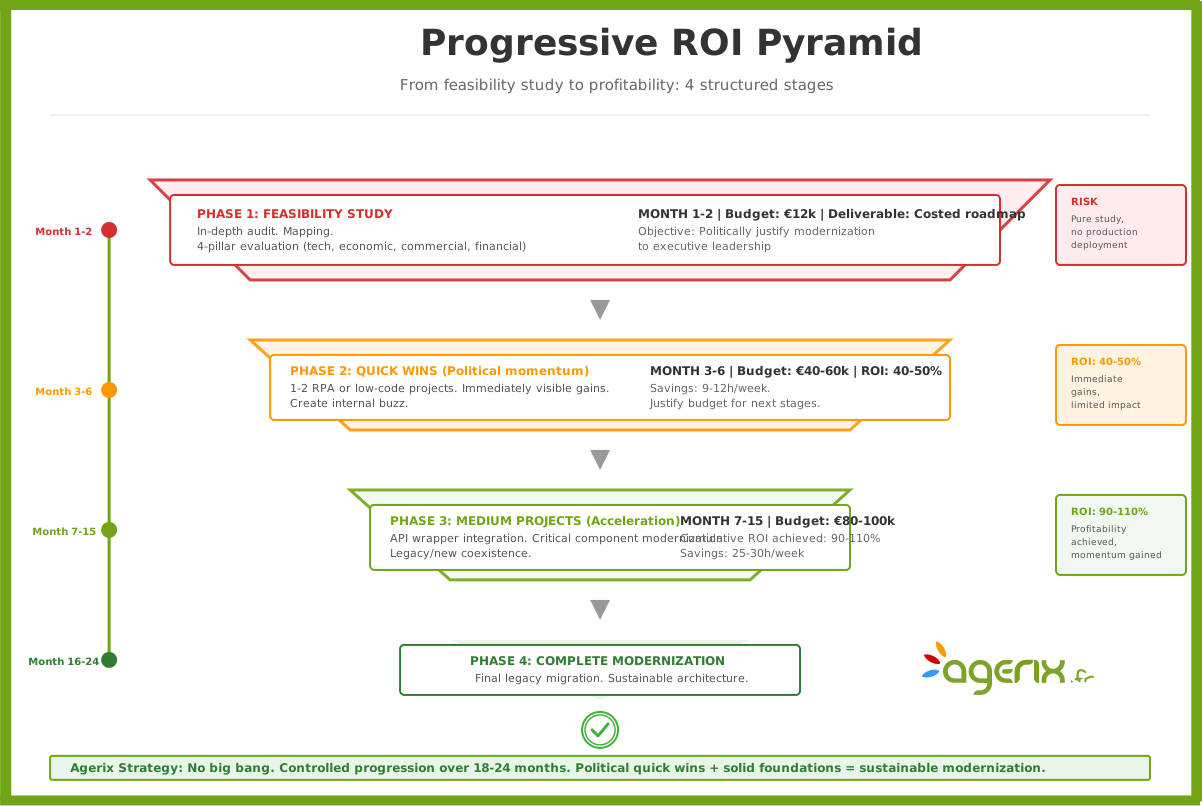
Step 1: Audit & Mapping (The Agerix Feasibility Study)
Before changing anything, you need to understand what’s actually running.
And I’m not talking about theoretical documentation. I’m talking about reality: who uses this system, to do what, and why it’s critical. What are the real dependencies (not those written in the 2008 document that no one has updated). Where are the breaking points.
This audit isn’t just an IT analysis. It’s a feasibility study—exactly as we’ve documented in our engagements. You need to evaluate four dimensions:
- Technical: the architecture, the state of the code, the dependencies
- Economic: the real cost of legacy vs. the cost of modernization
- Commercial: the business risks if you don’t modernize
- Financial: the realistic ROI and payback schedule
The result? Concrete quantification of the problem. Not approximations. Numbers. “You’re losing €120k/year in operational inefficiency. A progressive modernization project would cost €100-120k and pay for itself in 1.5 years.”
Suddenly, it’s easier to convince senior management. This is precisely what we deliver during an Agerix feasibility study.
Step 2: Phased Strategy (Cynefin + MoSCoW: The Agerix Framework)
Cynefin Framework: Modernizing Legacy Adapting the approach to problem complexity DISORDER (In crisis) SIMPLE (Obvious) Cause → Effect clear | Best practices ✓ Legacy Examples • Routine maintenance • Minor security patches • Standard bug fixes Agerix Approach: Documented processes and procedures. Automate as much as possible. Train the team once, then delegate. Continuous monitoring. ROI: Immediate savings. COMPLICATED Expertise needed | Analysis required ◆ Legacy Examples • Existing architecture audit • Dependency mapping • Modernization design Agerix Approach: In-depth strategic audit. Gather business + technical expertise. Evaluation of 4 pillars (technical, eco, commercial, fin). ROI: Solid foundations. COMPLEX Trial/Error | Iterative learning ◇ Legacy Examples • Actual progressive modernization • APIs + legacy integration • Phased migration Agerix Approach: Iterative pilot on small batch. Measure, adapt, progress. Deliver quick wins rapidly. Accept temporary imperfection. ROI: Progressive and tangible. CHAOTIC Crisis | Immediate action required ⚠ Legacy Examples • Major production outage • GDPR breach detected • Emergency migration required Agerix Approach: Immediate action (war room). Stabilize then diagnose. Fast-track contingency plan. Post-mortem and improvement. ROI: Future prevention. Cynefin for modernization: Each zone requires a different approach. Simple = procedures | Complicated = expertise | Complex = iteration | Chaotic = urgency. The Agerix strategy: Quickly identify the real complexity, then adapt the approach to maximize ROI and minimize risks.
Once you’ve mapped the system, you’ll prioritize. This is where we use the Cynefin and MoSCoW frameworks—tools we systematically apply at Agerix to manage the complexity of modernization projects.
MoSCoW is simple:
- Must: the critical business components. Billing for example. You can’t get this wrong. You secure it first.
- Should: the inefficient components that should be modernized. The CRM that requires 5 manual entries per transaction. It’s important, but not critical tomorrow.
- Could: future innovations. Things we’d like to do (AI, data analytics), but can wait.
And Cynefin tells you: for each component, what’s its complexity? Simple (replace directly), Complicated (study and plan), Complex (iterative approach), Chaotic (crisis situation).
Result: a realistic timeline. Not “we redo everything in 6 months”. Rather: “We modernize 15-20% per year. We keep legacy and new coexisting for 18-24 months. We accept this transition.”
This is exactly the approach we use when we manage complex projects for our clients.
MoSCoW Matrix: Prioritizing Modernization Ranking legacy components for a realistic plan LOW PRIORITY HIGH PRIORITY COULD Nice to have | Medium impact | Timeline: 18-24 months ★ Future innovations • Business Intelligence, Data Analytics • AI integration (recommendations) • Mobile app (mobile access) • Customer self-service portal • Social media integration Timeline: After 2+ years of modernization ROI: Long term, but high impact if successful SHOULD Important | Medium impact | Timeline: 12-18 months ◆ Essential business improvements • Automation of inefficient processes • Data quality improvement • Modern reporting, Dashboards • Improved ERP/CRM integration • Team collaboration (workflows) Phase 2 of modernization ROI: Medium term, gains after 12 months MUST Critical | High impact | Timeline: 0-12 months ✓ Critical business components • Customer data security (GDPR) • Audit trail, complete traceability • Billing/payment migration • Backups, business continuity • Authentication, access rights Immediate Phase 1 (existential risk) ROI: Prevention of major risks (GDPR fine 2M+) WON’T Out of scope | Low impact | Timeline: none x Deliberately postponed • Complete overhaul (big bang migration) • Aesthetic UI changes • Non-critical nice-to-have features • Old OS version support • Obsolete system integration Ignored for now (reevaluate year 3+) ROI: Negative or zero Agerix Strategy: We don’t modernize everything at once. MUST first (risks), then SHOULD (gains), COULD by observing. WON’Ts are deliberately ignored to stay focused on ROI and avoid effort dispersion.
Step 3: Avoiding “Perfection” Paralysis
Here’s the classic mistake we observe very often. You want the new system to be perfect before switching. Result? The project drags on, costs explode, the team loses motivation.
The real approach: accept temporary imperfection. Replace progressively. Accept that legacy and new coexist. Validate quick wins to maintain momentum.
For example: you replace order entry first (immediate gain: no more duplicates, 8h/week saved). Then billing (but it stays connected to the old database, via an API, to not break anything). Then progressively, you disconnect piece by piece.
It’s less “clean” architecturally. But it works. It creates small victories. And it avoids paralysis. This is the pragmatic approach we systematically recommend at Agerix.
Step 4: Governance & Real Measurements
Finally, who manages all this? This is crucial.
You need a clear RACI structure: who decides, who executes, who is consulted, who needs to be informed. You need a business sponsor (not just IT). You need to measure real gains after each step, not just “the project is progressing”.
Measured gain: “We eliminated 12 hours of manual work per week. Productivity gain: €31k/year.” Not “the system works better”.
Technologies & Approaches Suited for Legacy Modernization
Let’s now talk about the technical “how”.
APIs & Microservices: Progressive Decoupling
Here’s a powerful approach: you keep the legacy in place, but you “wrap” it with modern APIs.
Imagine: your old CRM stays in production. But instead of touching it directly, you create a modern API layer around it. New tools (a new reporting system, a marketing automation solution) no longer call the legacy directly. They go through the API.
Advantage? You protect the legacy. You progressively decouple the architecture. And tomorrow, when you’re ready, you can replace the legacy CRM without touching all the systems that use it.
This is real modernization without “big bang”, based on a sustainable architecture.
Cloud-Readiness & Hybrid
Most companies can’t migrate everything to the cloud at once. Sensitive data, complex GDPR compliance, critical business dependencies.
But you can migrate certain components. A reporting database can go to the cloud. Frontend web servers too. Critical data stays on-premise. You create a hybrid architecture progressively.
Advantage: fewer on-premise servers to maintain. Maintenance costs that drop. A more modern and scalable infrastructure.
Low-code & No-code: Accelerate
For certain business needs, you don’t need custom development. A low-code tool can do the job. And fast.
It’s useful for the “Should” components in your MoSCoW. No need for specialized developers. You configure. It works. You save months.
AI & Automation: Quick ROI
Here’s the approach that works best today for SMEs and mid-market companies: automate manual tasks related to legacy with AI and RPA (Robotic Process Automation).
You have a task that takes 3 hours/day and it’s manual data entry from one system to another. An RPA bot can do it. Bot cost: €40-60k. Savings: €50k/year. ROI: less than a year.
It’s not sexy. It doesn’t really modernize the architecture. But it creates real gains immediately. And it legitimizes the modernization investments that come after.
Real Case: From Inertia to Progressive Modernization
Concrete Case: 12-Month Timeline From feasibility study to project profitability 1 MONTHS 1-3 AUDIT AND MAPPING Key activities: • In-depth audit • Component mapping • 4-pillar evaluation • ROI calculation Budget: 12k euros Savings: 0 (setup phase) Deliverable: Roadmap 2 MONTHS 4-8 API WRAPPER INTEGRATION Key activities: • Create API wrapper • Connect new tool • Data synchronization • Integration testing Budget: 45k euros Savings: 9h/week = 23k euros/year 3 MONTHS 9-12 RPA AUTOMATION Key activities: • RPA implementation • Invoice automation • Testing, UAT validation • Production go-live Budget: 61k euros Savings: 19h/week = 49k euros/year Savings Progression 100k/year 0 Timeline (12 months) 3k 32k 95k Final Result (Month 12): Total budget 118k euros | Annual savings 95k euros/year | ROI achieved: 1 year 5 months
Let me tell you a true story (details anonymized).
An SME in the distribution sector, 55 employees. They sell industrial parts. Since 2001, they’ve been running on a proprietary order/billing system, custom-coded at the time. It’s one of those situations where the system works, but no one dares to really touch it.
We supported this SME at Agerix. Here’s what happened.
The real situation:
- 28 hours per week in manual work (order entry, billing, reconciliation with accounting)
- 2-3% of orders had errors (duplicates, wrong quantities)
- Zero traceability on access (GDPR = high tension with authorities)
- Customer data stored in clear text (no encryption)
- Growth blocked: impossible to quickly add new products or payment methods
The action plan (12 months):
Months 1-3: Feasibility study + Audit. What’s actually running? Where are the real costs? Where’s the ROI?
Discovery: the order system calls a proprietary database. But there’s also a weekly Excel export that goes to accounting. And another manual entry for billing. Three data silos. No synchronization.
Quantified cost: €92k/year in lost productivity (28h/week * €65/h * 50 weeks).
Months 4-8: API Layer + Integration. We create an API around the proprietary database (without touching it—progressive decoupling strategy). We connect a new modern order management tool to this API.
Result: data starts flowing automatically. No more Excel exports. No more manual entry in accounting. 9h/week saved immediately.
Months 9-12: RPA Automation for billing. We implement an RPA bot that automatically generates invoices, validates them, sends them. The work humans were doing manually.
Result: 19h/week of manual work eliminated. Errors reduced to 0.2%. Complete audit trail.
Final figures (Agerix):
- Total modernization budget: €118k (feasibility study, API wrapper, new tool, RPA, training)
- Annual savings: €95k (28h/week * €65/h * 52 weeks)
- ROI: 1 year 5 months
- GDPR compliance: achieved (encryption, traceability, controlled access)
Key success factors:
- No architectural perfection. API wrapper + temporary legacy/new coexistence = pragmatic Agerix approach, simple and it works.
- Business user involvement from the start. Less resistance to change.
- Measuring gains after each step. It creates political momentum. “We saved 9h/week, it’s already profitable.”
- Acceptance of temporary legacy. No risk. The old system stays as backup for 12 months if needed.
This is exactly the type of project where we excel at Agerix: SMEs and mid-market companies facing legacy they can’t ignore, but can’t afford to rewrite all at once either.
Checklist: Where to Start Tomorrow?
Do you recognize yourself in this situation? Here’s how to start, concretely.
Within 15 days:
Convene business managers AND IT managers (same table). Together, list the 3 most costly legacy systems. For each, ask the question: “If this system stopped tomorrow, what would the impact be?” In terms of hours lost, missed revenue, risk.
You have your 3 priorities.
Within 1 month:
Launch a micro-feasibility study on priority #1. You don’t need a 3-month study. One week of IT + business work. Result: 80% of the answers. “How much would it cost to modernize? What ROI? What risk?”
In parallel, identify 1 quick win. A small manual task that can be automated quickly (RPA, low-code). Something that shows visible gains in less than 2 months.
Within 3 months:
Launch the pilot on the quick win. Automate that task. Measure the real gain. Show it to senior management. Suddenly, modernization is no longer abstract. It’s “we saved €15k in 60 days and it worked”.
This creates the political momentum for the more ambitious projects that follow.
Three further readings extend this overview. Before committing to modernisation, the real cost of the existing system has to be made explicit, which reducing technical debt sets out. Modernising does not always mean rebuilding, and the trade-off often lies in the upkeep of the application lifecycle, whose scope is mapped by the four forms of application maintenance. When ageing affects usage as much as code, the question becomes that of a redesign that goes beyond a simple facelift.
Conclusion: Turning the Weight into an Asset
Let’s go back to the beginning. You have a legacy IS that costs much more than you think. Not just in maintenance budget. In operational inefficiency, in lost agility, in compliance risks, in growth constraints.
For an average SME or mid-market company, that’s €120k to €150k per year in hidden costs. Maybe more.
The good news? You don’t have to redo everything at once. Progressive modernization, over 18-24 months. APIs that wrap the old. Components replaced bit by bit. Quick wins that create momentum.
Yes, it requires structure. A solid feasibility study. A clear strategy (MoSCoW + Cynefin). Governance. But it works.
At Agerix, this is exactly what we’ve been doing since 2015. We help SMEs and mid-market companies transform their legacy IS into a competitive asset, whether it’s modernizing existing systems or deciding between off-the-shelf software and custom development. Our approach: strategic audit + real mapping + phased modernization + concrete ROI measurement. We reconcile legacy and innovation—not one or the other.
We’ve learned one thing supporting dozens of projects like this: successful modernization is never a technology question. It’s a question of strategy, governance, and the courage to accept temporary imperfection.
Do you recognize yourself? Start with the feasibility study. It’s the starting point to transform what’s blocking you into a competitive asset. That’s exactly what we excel at at Agerix.
Eric Lamy
Published on 30 October 2025 — updated on 29 January 2026